Digital Marketing
Social Media Marketing: A Complete Guide & Strategy for 2026
India now has over 500 million active social media users, and the average Indian spends close to 2.5 hours a day scrolling Instagram, YouTube, and Facebook. That’s not just screen time—it’s attention someone in this field gets paid to capture, understand, and convert. Social media marketing is exactly the skill that makes that possible: using platforms like Instagram, LinkedIn, Facebook, and YouTube to promote a brand, connect with real people, and turn followers into paying customers.
If you’re an aspirant looking to build a career in this space—a student, a fresher, or someone switching fields—here’s the good news: Social Media Marketing doesn’t ask for a specific degree, just skill, curiosity, and consistency. It has quietly become one of the most in-demand digital marketing careers in India, with brands, agencies, and startups constantly hiring people who understand how to grow a brand online. This guide walks you through everything you need to actually understand Social Media Marketing—from the fundamentals to the AI-driven tools shaping the field in 2026.
What Is Social Media Marketing?
Table of Contents
At its core, social media marketing means creating content, running ads, and building community on social platforms to grow a brand’s visibility, trust, and sales. It’s not just “posting reels.” It’s a mix of storytelling, data, and consistency—repeated week after week, month after month.
Ask any experienced social media manager and they’ll tell you the same thing: consistency beats creativity. A brand that posts average content every single day, replies to every comment, and shows up reliably will almost always outperform one that occasionally drops a “perfect” viral video and then disappears for a month.
This includes:
- Paid campaigns and ads – Boosted posts, lead generation ads, and retargeting campaigns designed to reach people who wouldn’t have found the brand organically.
- Engagement strategies – Contests, collaborations, influencer tie-ups, and active community management that keep the audience interacting rather than just scrolling past.
- Growth tactics – Content calendars built specifically to increase reach, followers, and conversions in a planned, measurable way, rather than posting randomly.
- Performance tracking – Monitoring CTR, engagement rate, cost-per-lead, and ROAS to know exactly what’s working and where the budget should shift next.
What Is Social Media Optimization (SMO)?
SMO is the groundwork. It’s everything you do to make your social presence discoverable, credible, and easy to engage with — without spending a rupee on ads.
This includes:
- Profile optimization — a clear bio, consistent branding, working links, and a recognizable profile photo/logo
- Hashtag research and placement — using the right mix of branded, niche, and trending hashtags
- Page structure — organizing highlights, pinned posts, content categories, and CTAs so visitors know what to do next
- Consistency — posting schedules, tone of voice, and visual identity that make your page feel established, not abandoned
Think of SMO as interior design for a shop. Nobody’s walked in yet, but when they do, everything is arranged so they instantly understand what you sell and trust that you’re legit.
If SMO is setting up the shop, SMM is the salesperson standing at the door, actively pulling customers in — and unlike a one-time setup, this salesperson never really stops working.
Social Media Marketing vs Social Media Optimization : Side-by-Side Comparison
| Aspect | Social Media Marketing | Social Media Optimization |
| Goal | Reach & conversions | Reach & conversions |
| Cost | Usually paid | Mostly free/organic |
| Timeframe | Campaign-based, time-bound | Ongoing foundation work |
| Key actions | Ads, promotions, engagement | Bio, hashtags, page structure |
| Analogy | The salesperson bringing in customers | Setting up the shop |
Why You Need Both — Not One or the Other
A common mistake: businesses jump straight into running ads (SMM) without fixing a weak, inconsistent profile (SMO) first. Result? Paid traffic lands on a page that looks unfinished, and conversions drop.
The reverse is also true — a beautifully optimized profile with zero active promotion just sits there quietly, growing at a snail’s pace.
The right sequence is almost always: SMO first, SMM second. Build the foundation, then bring in the traffic.
Why Social Media Marketing Matters in 2026
Social media isn’t a “nice to have” channel anymore — for most brands in 2026, it’s often the first place a potential customer encounters them, before the website, before a Google search, sometimes even before word-of-mouth. With attention spans shrinking and algorithms constantly rewarding fresh, relevant content, businesses that treat social media marketing as an afterthought are quietly losing ground to competitors who treat it as a core growth channel. For anyone building a career in this space, this also means the demand for skilled SMM professionals keeps climbing — brands need people who can not only create content but actually understand platform behavior, audience psychology, and performance data well enough to turn attention into actual business results.
Key Parts of Social Media Marketing
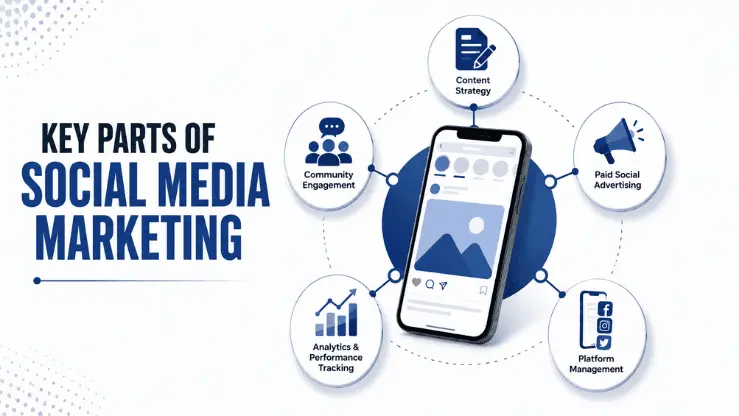
If you’re starting out as a social media marketer, understanding the five pillars of social media marketing isn’t optional — it’s the difference between sounding like a fresher in an interview and actually being job-ready. Every agency, brand, or client you work with will expect you to move fluidly between these five areas, often within the same week and across completely different accounts.
As an aspirant, your goal isn’t just to know what each pillar means — it’s to understand how they connect, so that when you’re asked to “grow engagement” or “improve reach,” you instinctively know which pillar you’re actually working within, and which skill you need to bring to the table.
Let’s go through each one.
- Content Strategy—What to post, why, and for whom.
- Community Engagement—Replying to DMs, comments, and building real conversations.
- Paid Social Advertising—Boosted posts and targeted ad campaigns.
- Analytics & Performance Tracking—Numbers that tell you what’s actually working.
- Platform Management—Scheduling, consistency, and cross-platform coordination.
Miss even one of these, and the whole effort starts feeling scattered—great content with no engagement looks just as weak as ads with no strategy behind them. Treat these five parts as a skill checklist to build, not a menu you choose from.
Why Is Social Media Marketing (SMM) So Powerful?
Before diving into tools, metrics, or campaign structures, it helps to step back and understand why this field exists in the first place — and why companies are willing to pay for it. From here on, we’ll walk through five things every aspiring SMM professional needs to internalize: why SMM works the way it does, how it actually functions behind the scenes, what makes content shareable enough to spread on its own, which metrics separate real growth from vanity numbers, and finally, an honest look at what makes this field rewarding — and where it gets genuinely hard. Think of this as the roadmap connecting theory to the actual skills you’ll use on the job.
Connection
Unlike a billboard or a TV ad, social media lets a brand talk directly to its audience—and the audience can talk back. That two-way street builds trust faster than almost any other channel.
Interaction
Comments, polls, live sessions, and DMs—every interaction is a small trust deposit. Brands that reply quickly and genuinely almost always see better loyalty and repeat purchases.
Customer Data
Every like, share, and click leaves a data trail. Marketers use this to understand what content works, what doesn’t, and who exactly is engaging—insight that used to take expensive market research to uncover.
Put these three together—connection, interaction, and data—and you get a channel that is cheaper than TV, more measurable than print, and more personal than either. That combination is precisely why even small local businesses in India, with modest budgets, can compete for attention against much bigger brands.
How Social Media Marketing (SMM) Works
At its core, Social Media Marketing works on a simple loop: create content, distribute it to the right audience, measure how it performs, and refine based on what you learn. As an aspirant, this is the cycle you’ll be running almost daily — planning what to post, deciding whether it needs paid boost, publishing it at the right time, and then going back to check whether it actually moved the needle. Platforms use algorithms to decide who sees what, which means your job isn’t just “posting content” — it’s understanding how each platform rewards certain types of content and behavior, then working with that system instead of against it.
The Social Media Marketing Action Plan
As an aspiring social media marketer, this is the exact plan you’ll run for any brand or client you work with:
- Set Goals & KPIs – Brand awareness? Leads? Sales? Define it first.
- Know Your Audience (Customer Segmentation) – Age, city, interests, buying behaviour.
- Choose the Right Platforms—Don’t be everywhere; be where your audience actually is.
- Create & Schedule Content—Plan a calendar instead of posting randomly.
- Engage & Manage Community—This is where CRM comes in.
- Track Metrics & Optimize—Double down on what’s working, drop what isn’t.
Advantages and Disadvantages of Social Media Marketing (SMM)
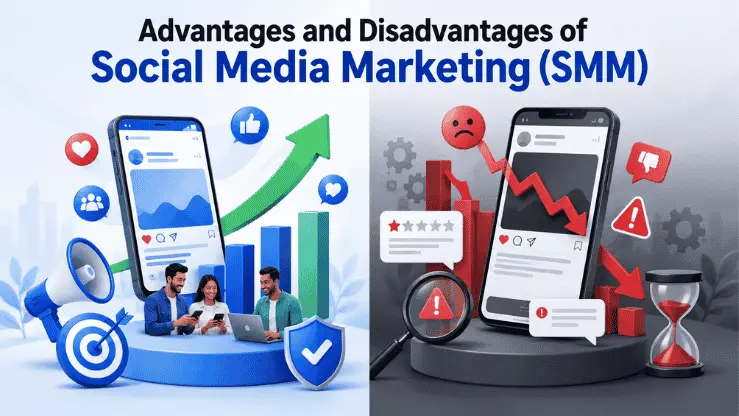
Advantages
- Stronger brand awareness – Consistent presence keeps your brand visible in front of the right audience, every single day.
- Direct customer feedback – Comments, DMs, and reactions give you real-time insight that surveys simply can’t match.
- Cost-effective reach – Compared to traditional media, SMM delivers significantly more reach and targeting precision per rupee spent.
- Faster lead generation – Paid campaigns and organic engagement together can shorten the path from “discovery” to “conversion.”
- Built-in audience access – Customers are already on these platforms every day, which is exactly why this skill set is in such high demand for anyone building a career in marketing today.
Disadvantages / Challenges
- Algorithm dependency – Reach can drop overnight when platforms change their rules.
- Negative feedback visibility – Complaints are public and spread fast.
- Time investment – Genuine engagement takes real, ongoing effort, not just scheduled posts.
None of these are reasons to avoid this field—they’re actually why skilled Social Media Marketing professionals are in demand. Anyone who can handle algorithm shifts, manage public criticism calmly, and stay consistent over time becomes genuinely valuable to hire.
Social Media Marketing Strategy
Setting SMART Goals
Specific, Measurable, Achievable, Relevant, Time-bound—vague goals like “grow followers” rarely convert into business results.
Content Pillars & Calendar Planning
Random posting rarely builds a brand—it just creates noise. Instead, pick 3-4 recurring content pillars and rotate through them every week:
- Education—tips, how-tos, myth-busting content that positions you as an expert
- Behind-the-scenes—your process, your team, the “real” side of the brand
- Product—features, use-cases, customer results
- Community—user-generated content, festivals, local moments, audience shoutouts
Once your pillars are set, map them onto a monthly content calendar with fixed posting days for each pillar. This single habit—planning a month ahead instead of scrambling every morning—is what separates brands that grow steadily from ones that post in bursts and then go silent.
Choosing the Right Social Media Platforms for Marketing
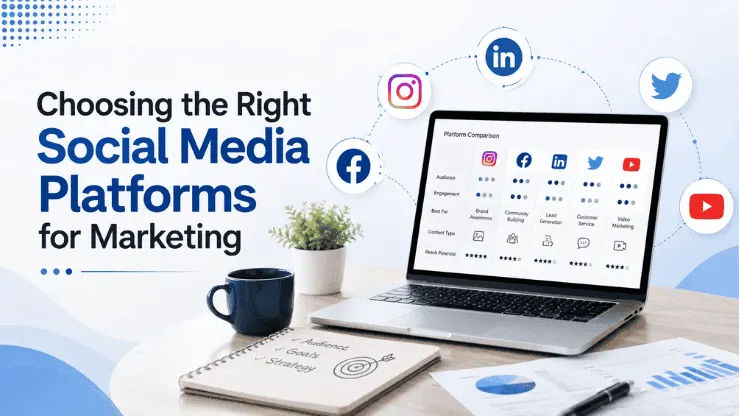
Not every platform deserves the same content, and not every audience is looking for the same thing. A reel that works on Instagram can fall flat on LinkedIn, and a founder-led thought leadership post that performs well on LinkedIn will likely get ignored on Facebook. As an aspiring SMM professional, one of the earliest skills to build is platform judgment — knowing where your audience actually spends time, and shaping content specifically for that space instead of recycling the same post everywhere.
- Instagram & YouTube – Best for visual storytelling, Reels, and Shorts. These two platforms reach a younger, mass Indian audience and reward consistency in short-form video far more than one-off viral attempts. Algorithms here favor creators who post regularly, use trending audio, and hook viewers in the first 2-3 seconds — making them ideal for brand discovery and top-of-funnel awareness.
- LinkedIn – Built for B2B, professional services, and thought leadership. It works best with founder-led posts, case studies, and industry insights, rather than overtly promotional content — the platform’s audience actively skips anything that feels like a hard sell. It’s also where decision-makers and hiring managers actually spend time, making it valuable for both brand credibility and lead generation in B2B niches.
- Facebook – Still strong for local businesses, community groups, and a slightly older, family-oriented demographic, especially across tier-2 and tier-3 India where it remains a primary social platform. Facebook Groups and local business pages continue to drive real engagement here, particularly for services like clinics, coaching centers, and retail stores with a local customer base.
- X (Twitter) – Ideal for real-time news, quick brand updates, and public customer support — less about polished content, more about speed, voice, and timely responses. Brands that handle customer queries visibly and quickly on X often build more trust than those relying on private support channels alone.
Which platform fits which business:
- D2C and lifestyle brands → lean into Instagram
- B2B and consulting firms → lean into LinkedIn
- Local service businesses (salons, clinics, restaurants) → do well on Facebook and WhatsApp Business
- News-sensitive or customer-support-heavy brands → benefit from an active presence on X
A common mistake among beginners is trying to be active on every platform from day one. It’s more effective to master one or two platforms where your audience genuinely spends time and build a consistent rhythm — better to be excellent on two platforms than mediocre on five.
Types of Social Media Marketing
Social Media Marketing isn’t a single activity — it’s an umbrella covering several distinct approaches, and most brands end up using a mix of these rather than relying on just one. As an aspirant, understanding each type individually helps you figure out which skill set to sharpen first, since agencies and clients often specialize in only two or three of these at a time.
Types of SMM
- Organic Social Media Marketing – Growing reach and engagement without paid promotion, through consistent posting, hashtags, and genuine community interaction. This is the foundation every brand starts with before layering paid efforts on top.
- Paid Social Media Advertising – Running targeted ad campaigns on platforms like Instagram, Facebook, or LinkedIn to reach specific audiences faster than organic growth alone can manage. This is where budget, targeting skills, and ad-copy writing come together.
- Influencer Marketing – Partnering with creators who already have an engaged audience to promote a product or service through authentic, trust-based content rather than a direct ad.
- Community Marketing – Building and nurturing spaces — Facebook Groups, Discord servers, WhatsApp communities — where customers engage with each other and the brand, creating loyalty that goes beyond a single post or campaign.
- Video Marketing – Using formats like Reels, Shorts, and long-form YouTube videos to tell stories, demonstrate products, or build brand personality — currently one of the highest-reach formats across almost every platform.
- User-Generated Content (UGC) – Encouraging real customers to create and share content featuring the brand, which tends to feel more authentic and trustworthy than brand-produced content alone.
- Social Commerce – Selling directly through social platforms via shoppable posts, Instagram/Facebook Shops, or live-selling features, shortening the gap between discovery and purchase.
Which platform fits which business:
- D2C and lifestyle brands → lean into Instagram
- B2B and consulting firms → lean into LinkedIn
- Local service businesses (salons, clinics, restaurants) → do well on Facebook and WhatsApp Business
- News-sensitive or customer-support-heavy brands → benefit from an active presence on X
A common mistake among beginners is trying to be active on every platform from day one. It’s more effective to master one or two platforms where your audience genuinely spends time and build a consistent rhythm—better to be excellent on two platforms than mediocre on five.
Social Media Marketing Tools
Managing SMM manually across multiple platforms and accounts doesn’t scale — which is why tools exist. As an aspirant, knowing which tool handles scheduling, analytics, or reporting matters as much as knowing strategy itself. Here’s a practical breakdown of the tools you’ll actually use on the job.
What Are Social Media Marketing Tools?
These are software platforms that help marketers plan, publish, monitor, and analyze their social campaigns without manually logging into five apps a day.
Categories of Tools
- Scheduling & Publishing—Buffer, Hootsuite, Sprout Social
- Analytics & Reporting—Meta Business Suite, Google Analytics
- Design & Content Creation—Canva, CapCut
- Social Listening Tools—Track brand mentions and sentiment in real time
As an aspirant, you don’t need to master every tool on this list. One scheduling tool, one analytics dashboard, and Canva are enough to build real, job-ready skills—add more tools only once you can clearly explain what problem each one solves.
Role of AI in Social Media Marketing
How AI Is Changing Content Creation & Scheduling
AI tools now draft captions, suggest optimal posting times, and even generate first-draft visuals—cutting production time significantly for lean marketing teams.
AI for Personalization & Ad Targeting
Machine learning models predict which audience segment is most likely to convert, letting brands personalize ad creatives at a scale no human team could manage manually.
AI Tools Marketers Are Using in 2026
From AI-assisted copywriting tools to smart scheduling assistants and predictive analytics dashboards, most serious social media marketing teams in 2026 are blending human creativity with AI efficiency—not replacing one with the other.
That said, AI still can’t replace the human judgment of knowing what will actually resonate with an Indian audience during, say, a festival season or a cricket match. The smartest teams use AI to save time on the repetitive parts of the job, so more energy goes into the strategy and creative decisions that genuinely move the needle.
Social Media Marketing Metrics to Track
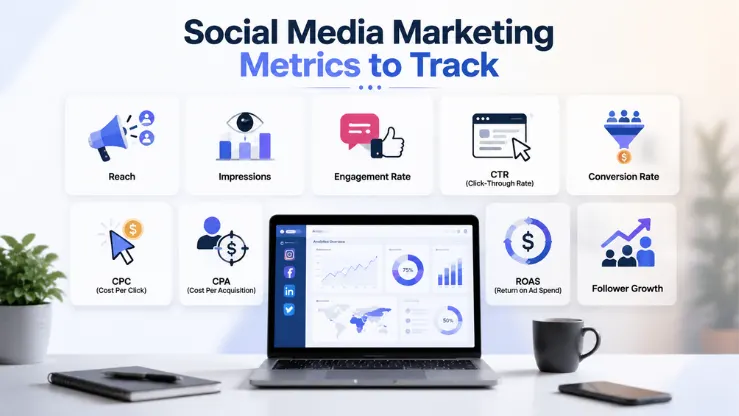
Numbers tell the real story behind any campaign — and knowing which metric answers which question is a skill in itself. As an aspirant, you’ll be expected to not just report these numbers, but explain what they mean and what action they call for.
Reach
The total number of unique people who saw your content — a measure of visibility, not engagement.
Impressions
The total number of times your content was displayed, including repeat views by the same person — useful for understanding how often your content is being shown.
Engagement Rate
The percentage of people who interacted with your content (likes, comments, shares, saves) relative to your reach or followers — a strong indicator of how well content actually resonates.
CTR (Click-Through Rate)
The percentage of people who clicked on a link or CTA after seeing your content — a key signal of how compelling your messaging and creative actually are.
Conversion Rate
The percentage of people who completed a desired action (purchase, sign-up, form fill) after clicking through — this is where reach and engagement translate into real business outcomes.
CPC (Cost Per Click)
How much you’re paying, on average, for each click on a paid campaign — a core metric for managing ad budgets efficiently.
CPA (Cost Per Acquisition)
How much it costs to acquire one paying customer or lead through a campaign — often the metric clients care about most.
ROAS (Return on Ad Spend)
The revenue generated for every rupee spent on advertising — the ultimate measure of whether a paid campaign is actually profitable.
Follower Growth
The rate at which your audience is growing over time — useful as a long-term trend indicator, though it should never be read in isolation from engagement and conversions
Conclusion
Social media marketing isn’t about chasing every trend or posting for the sake of posting — and if you’re building a career here, that’s actually good news. It means the fundamentals matter more than luck: understanding your audience, mastering one or two platforms deeply, reading data honestly, and staying consistent long enough for results to show. These are learnable, practical skills, not talent you’re born with. Start by picking one platform, one brand, or one personal project to practice on, and build from there—the tools and AI trends will keep evolving, but marketers who nail these basics will always stay relevant.
FAQs About Social Media Marketing
1. What is social media marketing in simple words?
It’s using platforms like Instagram, Facebook, and LinkedIn to promote a brand, connect with an audience, and drive business results—through a mix of content, ads, and genuine engagement rather than one-off posting.
2. What are the main types of social media marketing?
Organic content marketing, paid social advertising, influencer marketing, and community management are the four core types. Most successful brands run a blend of all four rather than relying on just one.
3. Is social media marketing the same as digital marketing?
No. SMM is one part of the larger digital marketing umbrella, which also includes SEO, email marketing, and paid search.
4. How much does social media marketing cost in India?
Costs vary widely — from a few thousand rupees a month for organic content in-house, to lakhs per month for larger paid campaigns and agency support.
5. Which social media platform is best for marketing in India right now?
It depends on the business—Instagram and YouTube work well for consumer brands, while LinkedIn is stronger for B2B and professional services.
6. Can I learn social media marketing without a technical background?
Yes. SMM is skill-based, not degree-based—a good social media marketing course covering strategy, content, tools, and analytics is enough to get started, and most successful social media managers today come from varied academic backgrounds, not just marketing degrees.
7. How long does it take to see real results from social media marketing?
Organic growth usually takes three to six months of consistent effort to show meaningful traction, while paid campaigns can generate faster, more immediate results — though they require an ongoing budget to sustain that momentum.
8. What skills do I need to start a career in social media marketing?
A working understanding of content creation, basic design tools like Canva, analytics reading, and platform-specific best practices covers the fundamentals. Communication skills and a genuine curiosity about trends matter just as much as any technical tool.


Recommend The Best Learning Path Tailored To Your Needs
Discuss your career goal with experienced trainers for clarity.

