Digital Marketing
Digital Marketing Course for Housewives — Learn From Home, Earn Flexibly, Restart Your Career
You already run a household on a budget, juggle ten things at once, and know how to persuade people. Those are marketing skills. Here’s how six practitioners turn them into income you earn from home.
She sent the message after everyone else was asleep. A mother of two in Indore, up at 11 p.m., typing quietly: “I have a commerce degree I never used. My youngest just started school. I have maybe three hours a day. Is it too late for me to earn something of my own?”
It is not too late. It is, in fact, one of the best moments in a decade to start.
That question is why so many women search for a digital marketing course for housewives. Not because they lack ability — running a home on a fixed budget, coordinating a family’s schedule, calming a difficult relative, stretching one income across many needs — those are real skills. Organization, negotiation, communication, and patience are exactly what marketing rewards. The gap isn’t talent. It’s a structured way to point those skills at paid work that fits around family life.
And the timing is genuinely good. India’s 2026 India Skill Report found women’s employability climbed to 54%, overtaking men for the first time in five years — and flexible, remote work is the main reason. Research shows women are three times more likely to take up work when the arrangement is flexible. Digital marketing is one of the few real careers you can build almost entirely from home, at hours you choose.
This article was written by six people who do this work every day — including one who restarted her own career exactly this way. We’ll show you what a digital marketing course for homemakers actually teaches, the honest income you can expect, how to land your first client, and how AI is opening new doors. No hype. Just a clear path written for the woman reading this at 11 p.m., wondering if it’s her turn now.
Why Digital Marketing Fits a Homemaker’s Life
Table of Contents
I’ll be honest with you, because I’ve been where you are. I left work when my first child was born and told myself I’d “get back to it later.” Later kept moving. When I finally started a digital marketing course for women returning to work, my biggest fear wasn’t the skills — it was whether my life had room for it.
It did. And here’s why this field, specifically, fits.
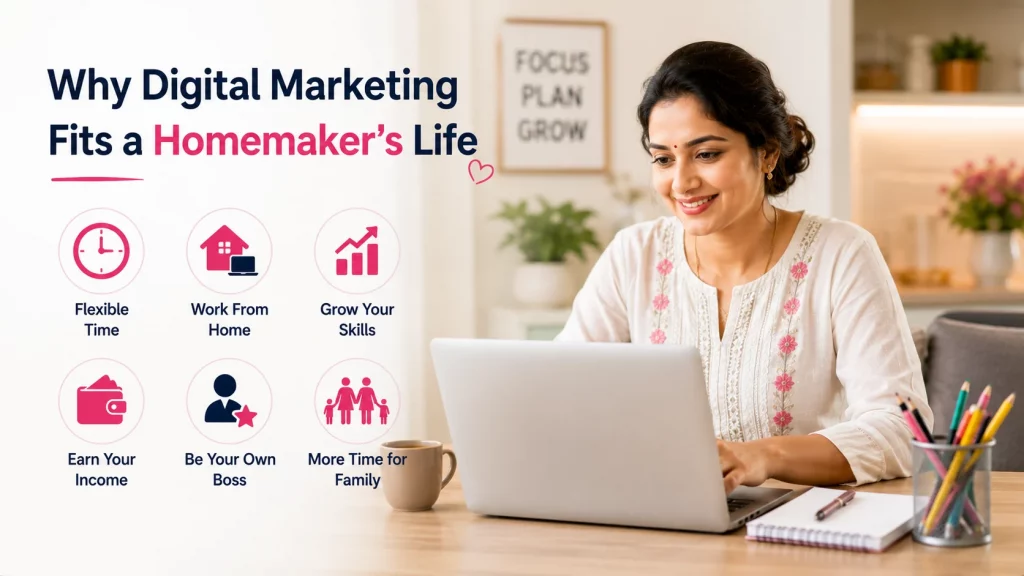
Most digital marketing work is done on a laptop, on your schedule. A social media post can be planned at 6 a.m. or 11 p.m. Client calls take thirty minutes. You are paid for results, not for sitting in an office chair from nine to five. For a woman who carries most of the household and care work — and studies show Indian women spend far more time on that than men — this flexibility isn’t a perk. It’s the whole thing. A work from home digital marketing course for housewives is built around that reality.
The skills also build on what you already have. The mistake I watch women make is assuming they’re “starting from zero.” You’re not. If you’ve managed a family WhatsApp group, you understand audience. If you’ve compared prices across three shops, you understand value and positioning. If you’ve calmed an upset relative, you understand messaging. A digital marketing course for stay at home moms simply gives those instincts professional tools and names.
And you can start small. You don’t need to quit anything or commit to full days. A good part time digital marketing course for women lets you learn a few hours at a time and earn a part-time income that grows as your hours free up. Many women begin with one small local client — a boutique, a tuition centre, a clinic — and build from there. If you want to see how structured, supportive training is delivered, look at the digital marketing coaching program from Digitally Code, which is set up for exactly this kind of practical, step-by-step learning.
The deeper reward isn’t only money. It’s financial independence — your own income, your own identity, your own bank account. I’ve watched it change how women carry themselves. That’s worth more than any salary figure.
The Beginner-Friendly Skills You’ll Actually Learn
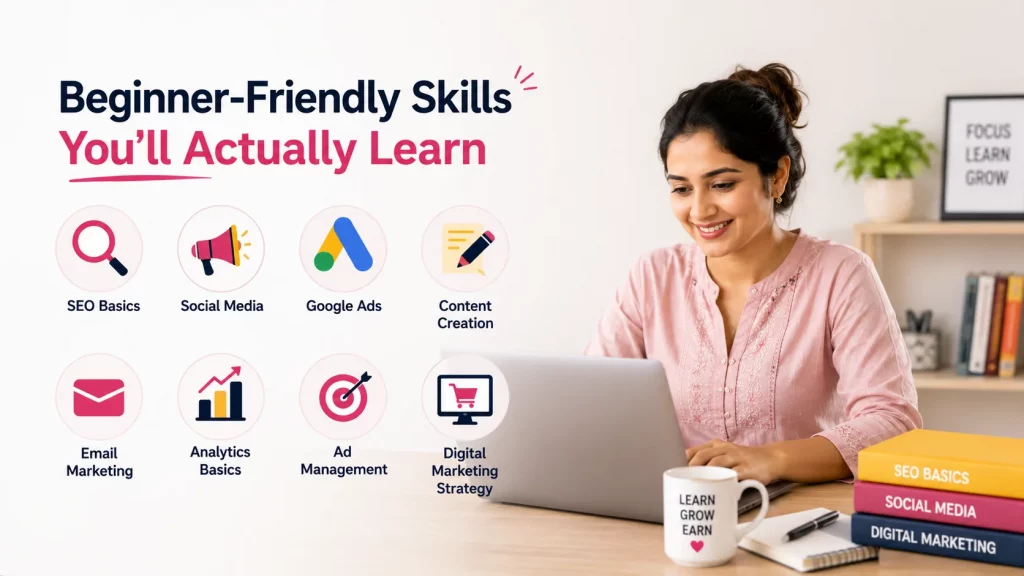
When women ask me “can housewives learn digital marketing,” my answer is always the same: yes, and usually faster than fresh graduates, because you already have discipline and follow-through. Let me walk you through what a good digital marketing training for housewives teaches, from easiest to most advanced.
Social media marketing is the gentlest starting point. A social media marketing course for housewives teaches you to plan content, write captions, schedule posts, and read what’s working — skills many homemakers already use informally. Small businesses pay steadily for this, and it needs only ten to fifteen hours a week.
Content writing comes next, and it’s a natural fit. If you can write a clear message, you can earn. A content writing course for housewives covers blogs, website copy, product descriptions, and newsletters. Add a blogging course for housewives and you can even build your own income stream over time.
Design removes the “but I’m not technical” fear fast. A canva design course for housewives teaches you to make professional graphics with free, simple tools — no design degree needed.
Then the higher-value skills. A seo course for housewives teaches how to help websites rank on Google — a skill that commands premium rates and builds over time. An email marketing course for homemakers covers writing subject lines and setting up automated sequences with beginner-friendly tools. And paid ads — through a google ads course for housewives and a facebook ads course for women — put you inside real campaigns, which is where the strongest earning is.
You can also specialize toward independence: an affiliate marketing course for housewives, an ecommerce reselling course for housewives, a virtual assistant course for housewives, or an influencer marketing course for housewives if you enjoy being on camera. Many women blend a few of these into a digital marketing for mompreneurs path and run their own small home business.
What I consistently see work best is live practice. A digital marketing course for housewives with certificate that includes real projects — a genuine page, a genuine post, a genuine ad — produces women who can actually do the work, not just describe it. To understand the professional standard your work should reach, look at how a full-service digital marketing company handles SEO, ads, and content end to end.
The Real Income and Opportunity — With Honest Numbers
Let me give you the numbers plainly, because false promises help no one and honest ones help you plan.
First, the market. India’s digital marketing sector is large and growing fast, and digital now makes up roughly 60 to 68% of all advertising spend in the country. Every rupee of that needs someone to manage it, and businesses are struggling to find skilled people. That demand is what creates room for newcomers, including women restarting after a break.
Now, real earnings — the answer to “how much can a housewife earn from digital marketing.” At the start, handling social media for a couple of local shops might bring ₹15,000 to ₹25,000 a month for part-time hours. As you add skills, someone doing SEO or managing Google and Meta Ads can command ₹50,000 to ₹1,00,000 or more. Homemakers across India are already earning anywhere from ₹5,000 to ₹50,000+ a month through online work, depending on skill and time invested. Freelance platforms list work-from-home roles for women in the ₹10,000 to ₹40,000 range, and specialists on retainers earn well beyond that.
The pattern I want you to notice: income rises with skill depth, not with age or years of “experience.” A woman who spends six focused months learning SEO can be earning steady freelance income within a year. This is a best online career for housewives precisely because the ceiling is set by your skill, not your CV gap.
There’s a bigger picture too. India has roughly 300 million homemakers, and economists at institutions like Goldman Sachs note that raising women’s workforce participation could add meaningfully to national growth. You’re not an outlier for wanting this — you’re part of a large, rising wave. The digital marketing scope for women has never been wider.
The honest caution: this is skill-first, not certificate-first. Your portfolio — real results you can show — determines your pay, which is why choosing the right program matters. Before enrolling anywhere, review who’s teaching; the team behind Digitally Code is the kind of thing worth checking, because trainers who’ve actually run campaigns teach very differently from those reciting theory.
Running Ads and Tools From Your Kitchen Table
In my experience, this is the section that turns a learner into a paid professional. And I run all of it from home, around my own family’s schedule — so I promise you it’s possible.
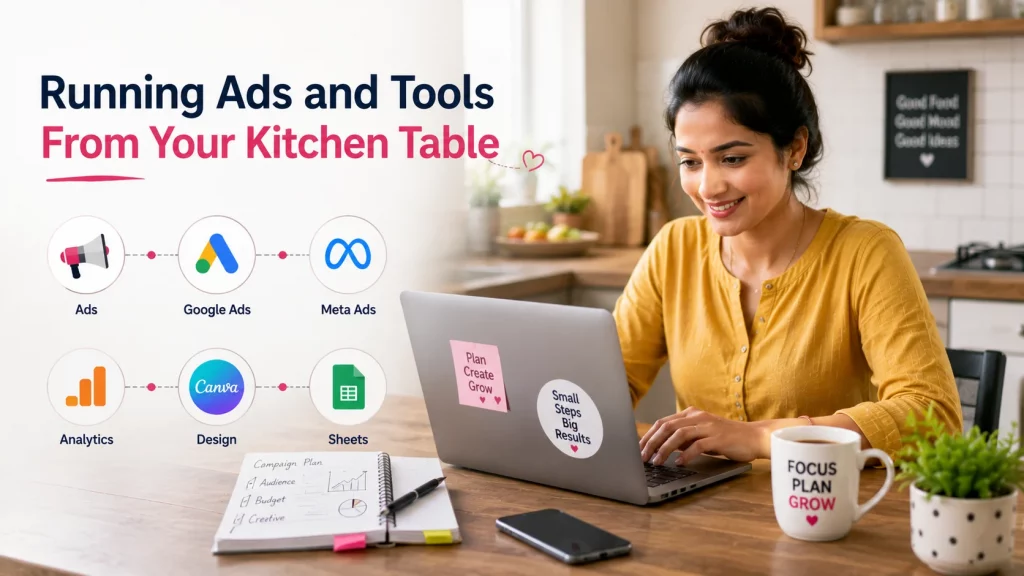
Paid advertising is where clients happily pay well, because it’s directly tied to their sales. A good performance marketing module in a digital marketing course for housewives at home has you actually running campaigns, not just watching videos about them. On Google, you’ll learn search and YouTube ads inside a real account. On Meta, you’ll work in facebook ads manager and meta business suite — building audiences, testing creatives, and using retargeting. This is full-funnel work, the kind a specialist Meta Ads management team runs across the whole customer journey.
The tools are friendlier than you’d expect, and many are free to start. Canva for beginners handles design. Mailchimp email marketing handles newsletters. Google Analytics 4 shows you what’s working. Google my business helps local shops get found. You can manage instagram marketing for housewives, run a whatsapp business for women channel to close leads, and even set up a shopify for home business store — all from one laptop.
Here’s a real example of why the right skills pay. A local furniture shop I helped was wasting money on broad English ads. We switched to targeted local ads with a WhatsApp button, and cost per lead dropped sharply while lead quality rose. Same budget, better math — because someone knew how to set it up. That “someone” can absolutely be you after proper training.
Two things I tell every woman I mentor. First, you don’t need expensive equipment — a reliable laptop and stable internet are enough to begin. Second, learn to read a dashboard early. When you can run the ads and explain the results, you become the person a small business can’t afford to lose. That’s also the discipline behind professional Google Ads management at agency scale.
AI Search and GEO/AEO — The Edge Most Courses Skip
Here’s a shift almost no digital marketing classes for housewives teach yet — and learning it early puts you ahead of marketers with years more experience.
For a long time, being found meant ranking on Google’s list of links. Now a growing number of customers ask ChatGPT, Perplexity, Gemini, or Google’s AI Overviews a question and get one answer, often without visiting any website. If a business isn’t inside that answer, it’s invisible to that customer. This is why generative engine optimization (GEO) and answer engine optimization (AEO) have become real, paid skills in barely a year.
The good news for beginners: this levels the field. Because it’s new, there’s very little competition. A woman starting fresh can learn how to rank on chatgpt and perplexity and google ai overviews optimization and be genuinely ahead — no decade of old habits to unlearn. An ai digital marketing course for housewives teaches you to structure content the way AI tools prefer to cite it.
AI also makes the daily work far easier, which matters when your time is limited. Chatgpt for beginners and other ai tools for content creation can draft captions, outline blogs, and brainstorm ideas in minutes. Ai tools for social media speed up scheduling and analysis. A little prompt engineering for beginners — just learning to ask well — means ai content writing for housewives becomes a genuine time-saver, not a gimmick. These no-code ai marketing tools were practically made for someone balancing work with family.
And it pays. Marketers who combine AI fluency with real strategy command noticeably higher rates — often 40 to 60% more at entry level than those who don’t. Learning ai marketing for freelancers early isn’t optional anymore; it’s the smartest thing a newcomer can do.
How It All Fits Together — and How You Get Your First Client
The women who succeed don’t learn ten skills in isolation. They understand how the pieces connect — and that understanding is what earns money.
Think of it as one loop. Social media and content build an audience and trust. SEO brings in people searching on Google. Google and Meta ads create demand and bring back people who didn’t buy the first time. Email and WhatsApp nurture those leads into customers. Analytics shows what’s working. And AI and GEO/AEO now sit on top, making sure AI answers recommend the business too. A program that teaches these as one system produces women who can walk into a small business and say, “Here’s how I’ll grow you” — which is exactly what wins clients.
Now, the real question: “how to start digital marketing as a housewife” and actually get paid. Here’s the honest path. Your certificate gets you noticed; your portfolio gets you hired. So during a digital marketing course for housewives with placement, do real projects — even unpaid ones for a friend’s business — so you have results to show. Then start local and start small: one boutique, one clinic, one coaching centre. Deliver well, ask for a referral, and grow from there.
There are three ways women build income from here, and a good course prepares you for all of them. You can take a flexible work from home job. You can freelance — many women build a full freelance digital marketing course for women practice, setting their own rates and hours. Or you can grow your own home business. For social-focused work, it helps to see how social media management is delivered professionally, so your own work meets that bar.
Whatever path you choose, judge every option — free or paid — by the same test: does it give you real projects, real tools, and real support? Start by exploring the Digitally Code homepage to see how learning, projects, and guidance connect, then hold every other best digital marketing course for housewives to that standard.
Frequently Asked Questions
Can a housewife with no experience learn digital marketing?
Yes, absolutely. Digital marketing skills are learnable, not innate, and homemakers often pick them up faster because they already have discipline, organization, and communication skills. A good digital marketing course for housewives starts from the very basics and walks you through real projects, so no prior experience or technical background is needed. Social media and content writing are the easiest entry points, and you build from there at your own pace.
How much can a housewife earn from digital marketing?
Realistically, beginners handling social media part-time for local businesses earn around ₹15,000 to ₹25,000 a month. As you add skills like SEO or Google and Meta Ads, that can rise to ₹50,000 to ₹1,00,000 or more. Many homemakers start at ₹5,000 to ₹10,000 while learning and grow steadily. The key factor is skill depth and consistency, not your age or career gap. Freelancers who specialize earn the most.
How much time do I need each day?
You can start with just two to three hours a day. Most digital marketing work is flexible and done on your own schedule, so you can fit it around household and family responsibilities — early mornings, school hours, or after everyone sleeps. As your income grows and your hours free up, you can scale up. This flexibility is exactly why digital marketing suits homemakers so well.
Is a digital marketing course for housewives worth the money?
If it includes live projects, real tools, and placement or freelance support, yes. The right course pays for itself quickly once you land your first client or job. Avoid theory-only programs — the value comes from building a portfolio of real work you can show. Judge a course by its outcomes and hands-on practice, not just its price or the certificate at the end.
Do I need a degree or English fluency to start?
No degree is required — digital marketing is a skill-first field, and your portfolio matters far more than your qualifications. Basic English helps because tools use English terms, but you don’t need to be fluent, and many concepts can be learned in Hindi or your own language. What matters most is willingness to learn and consistency. Women from every educational background succeed in this field.
What equipment do I need to start from home?
Very little. A reliable laptop and a stable internet connection are enough to begin. Many essential tools — Canva, Google Analytics, and free email marketing tiers — cost nothing to start. As you grow and earn, you can invest in premium tools, but they’re not a prerequisite. You do not need an expensive setup or an office to build a real income from home.
How do I get my first client as a housewife freelancer?
Start with your own network and go local. Offer to manage social media or run ads for a friend’s boutique, a nearby clinic, or a coaching centre — even at a low rate or free at first — to build a portfolio with real results. Then ask for referrals. A good course with placement support also connects you to opportunities. Most women land their first paid work within one to three months of finishing a hands-on program.
Which digital marketing skills should a beginner housewife learn first?
Begin with social media marketing and content writing — they have the lowest barrier to entry and rely on skills you likely already have. Add Canva design and basic SEO next. Then move to higher-paying skills like Google Ads, Meta Ads, and email marketing. Learning AI tools alongside these gives you a real edge, since they save time and command higher rates. A structured course sequences all of this for you.
Your Turn Starts Now
The mother in Indore who messaged at 11 p.m. enrolled the following week. She learned social media first, took on a neighbourhood boutique, then a clinic, then two more. Within six months she was earning a real, independent income — on her own hours, without leaving her children. She wasn’t special. She was consistent.
That is the whole promise of a good digital marketing course for housewives. It takes the skills you already use every day — organizing, persuading, managing, creating — and turns them into income you control, from home, on your schedule. It’s not too late, and you’re not starting from zero. If you’re ready to build something of your own, explore a practical, supportive digital marketing program and take the first step. Your household already runs on your skill. It’s time some of that skill paid you back.


Recommend The Best Learning Path Tailored To Your Needs
Discuss your career goal with experienced trainers for clarity.

