Digital Marketing
Digital Marketing Course: Complete Guide Before You Enroll

Every second LinkedIn post is either selling a digital marketing course or flexing one just finished. The hype isn’t baseless—India’s digital economy is growing faster than most traditional job markets, and companies genuinely need people who can run campaigns, read analytics, and write copy that converts. But here’s the catch: not every course is built the same, and picking the wrong one can cost you money and a year of your career. This guide covers what a digital marketing course actually teaches, what it costs in 2026, and how to spot a genuinely useful program versus a glorified PDF bundle with a certificate attached.
What Is a Digital Marketing Course?
Table of Contents
At its core, a digital marketing course is structured training that teaches you how brands find, engage, and convert customers online. That includes search engines, social platforms, email, paid ads, and the analytics that tie it all together. Some programs are three-week crash courses; others stretch across a year with live client projects built in.
What separates a course worth your time from one that isn’t is simple: does it teach execution, or just theory? A good program has you actually running a Google Ads account, writing SEO content that gets published, or managing a real (even if small) social media handle—not just watching someone else do it on a screen recording.
Skills You Actually Walk Away With
- Search engine optimization (on-page, off-page, technical)
- Paid advertising across Google and Meta
- Social media strategy and content calendars
- Copywriting and content marketing
- Analytics—Google Analytics, Search Console, ad dashboards
- Basic automation and AI-assisted workflows, increasingly a 2026 staple
Types of Digital Marketing You’ll Learn Inside a Course
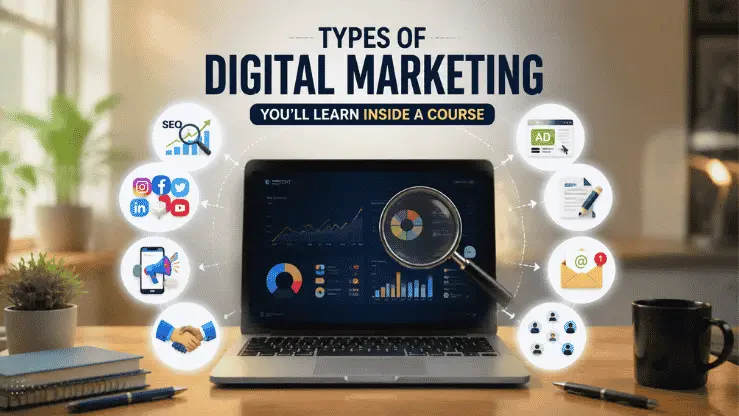
Before picking a program, it helps to know exactly what “digital marketing” is made up of. It’s not one single skill—it’s a set of channels, and a solid digital marketing course should walk you through each one with real practice, not just slides.
1. SEO—The Skill That Never Stops Paying You Back
SEO (Search Engine Optimization) is the practice of getting a website or piece of content to rank higher on Google—without paying a single rupee for ads. It’s the module every digital marketing course leans on the hardest because, unlike paid ads, SEO traffic keeps coming in even after you’ve stopped actively working on it. Here’s the catch—most people only know “SEO” as one thing, when it’s actually four very different skills stacked.
On-Page SEO: This is everything you control directly on your webpage or blog—keyword placement, title tags, meta descriptions, header structure (H1 to H6), internal linking, and content quality itself. A properly optimized page has the focus keyword early, naturally repeated at a healthy density, and organized so both readers and search engines understand it instantly.
Off-Page SEO: Everything that builds your site’s authority from outside your own website—backlinks from credible sites, guest posting, brand mentions, and social signals. Google treats this as a trust score: the more quality sites vouching for you, the higher you tend to rank.
Technical SEO: The behind-the-scenes engineering—site speed, mobile responsiveness, crawlability, XML sitemaps, structured data (schema), and fixing broken links or duplicate content. You can write the best content in the world, but if the site loads slowly or Google can’t crawl it properly, none of it matters.
Local SEO : Critical for any business targeting a specific city or region—think Google Business Profile optimization, local citations, location-based keywords, and review management. This is what determines whether a business shows up when someone searches “digital marketing agency near me.”
A digital marketing course that skips any one of these four is teaching you SEO with a missing leg.
2. Social Media Marketing (SMM/SMO)—Where Most Beginners Actually Start
This covers building and growing a brand’s presence on platforms like Instagram, LinkedIn, YouTube, and increasingly Threads and X. It’s far more than “posting daily” — it includes content calendars, community management, organic growth tactics, hashtag and trend strategy, and short-form video (Reels, Shorts) as the dominant format in 2026. A good digital marketing course teaches SMM as a strategic function tied to actual business goals—follower count without engagement or conversion means very little.
Within SMM itself, there are distinct sub-skills worth knowing: organic social (growing reach without ad spend, purely through content and consistency), paid social (boosting posts and running ad campaigns for reach or conversions), and community management (responding to comments, DMs, and building an actual relationship with the audience instead of just broadcasting at them). Brands increasingly hire specifically for one of these three, so a well-rounded digital marketing course should expose you to all three rather than treating SMM as one single skill.
3. Pay-Per-Click Advertising (PPC/SEM)—Where You Learn to Spend Money to Make Money
PPC is paid advertising on platforms like Google Ads and Meta Ads, where you pay only when someone clicks your ad. On the surface it sounds simple—set a budget, pick keywords or an audience, launch. In practice, it’s one of the most technical and high-stakes skills in the entire field, because a badly managed campaign can burn through a company’s budget in hours with nothing to show for it.
A proper module covers campaign structuring (search vs display vs shopping vs video ads), audience targeting and retargeting, bid strategies, A/B testing ad creatives, and—most importantly—reading performance metrics like CAC (Customer Acquisition Cost) and ROAS (Return on Ad Spend) to know whether a campaign is actually profitable or just generating clicks. This is often the highest-paying specialization coming out of any strong digital marketing course, precisely because the impact on revenue is so directly measurable.
4. Content Marketing—The Skill That Powers Every Other Channel
Content marketing is about creating blogs, videos, and guides that attract and retain an audience—this very article is an example of it in action. It focuses on writing for conversions, not just word count, and increasingly, structuring content so it performs well in both traditional search and AI-driven answers like the ones showing up at the top of Google now.
This module typically covers blog and article writing, video scripting, infographics, case studies, and lead magnets like eBooks or checklists. The real skill isn’t just “writing well” — it’s understanding search intent, structuring content around what the reader actually wants to know, and building a distribution plan so the content doesn’t just sit unread. A digital marketing course that treats content as a standalone module (rather than folding it into SEO alone) tends to produce far stronger writers and strategists, because content marketing today overlaps with SEO, social, and email all at once.
5. Email Marketing— Old-School, Still Undefeated
One of the highest-ROI channels still in use — building email lists and sending sequences that nurture leads into paying customers. It sounds old-school next to Instagram Reels or AI chatbots, but industry data consistently shows email marketing delivering some of the strongest returns of any digital channel, simply because you own the list—no algorithm can suddenly hide your message from people who’ve already opted in.
A solid module covers list building, segmentation (sending the right message to the right group instead of blasting everyone the same email), automated drip sequences, subject line and open-rate optimization, and platforms like Mailchimp or HubSpot. It remains one of the most cost-effective channels covered in any serious digital marketing course, and it’s often the first channel small businesses can run entirely on their own once trained.
6. Affiliate Marketing—Earn While You Recommend
This involves promoting other brands’ products and earning a commission every time someone buys or signs up through your unique tracking link. It’s one of the most accessible ways to turn an audience into income—no product of your own required, no inventory, no customer support headaches. It’s become a common monetization path for content creators, bloggers, and YouTubers who’ve completed a digital marketing course and want to build an independent income stream on the side of (or instead of) a full-time job. The skill that actually determines success here isn’t luck—it’s understanding your audience well enough to recommend things they’ll genuinely act on.
7. Influencer Marketing—The Trust Shortcut Brands Are Paying Big For
Brands partner with creators to borrow their built-in, trusting audience—because a recommendation from someone you already follow converts far better than a cold ad. This module usually covers how to identify the right influencers for a niche, structure and negotiate deals, and measure actual ROI beyond vanity metrics like follower count. In 2026, this has grown into one of the fastest-expanding disciplines taught inside a modern Digital Marketing Course, especially with micro and nano-influencers proving more cost-effective than big celebrity endorsements.
8. Mobile Marketing—Built for a Mobile-First India
SMS campaigns, app push notifications, in-app ads, and mobile-first ad formats are grouped under this channel—and it matters more in India than almost anywhere else, given how much of the country’s internet traffic comes from mobile devices first, often skipping desktop entirely. This module usually covers mobile app store optimization (getting an app discovered on the Play Store), push notification strategy, SMS/WhatsApp marketing, and designing ads and landing pages that actually load fast and convert on a small screen. Any digital marketing course that ignores mobile-specific strategy is missing where most of the actual Indian audience already lives.
Why Digital Marketing Course Demand Is Growing in 2026
This isn’t a trend that appeared overnight. India’s e-commerce market is projected to keep climbing sharply, and government pushes like Digital India have only added fuel. Marketing jobs are expected to grow by roughly 10% between 2020 and 2030, and India’s internet-shopping base is now one of the largest in the world.
What’s changed more recently is who is enrolling. It’s no longer just fresh graduates—working professionals switching careers, small business owners who want to run their own ads, and freelancers building a second income stream are all showing up in the same batch. That mix is exactly why demand for a well-structured digital marketing course keeps rising instead of leveling off.
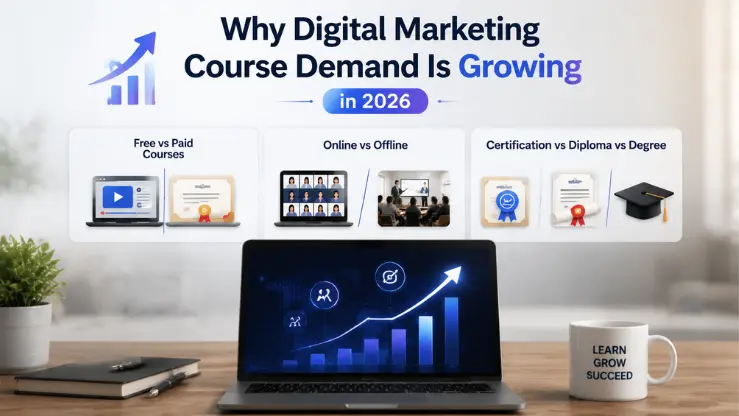
Free vs Paid Courses
Free options like Google’s Fundamentals of Digital Marketing, Meta Blueprint, and HubSpot Academy are legitimate places to start. These cover the basics of SEO, social media, email marketing, and analytics in a structured way and are widely recognised as foundational credentials. The honest catch — they teach concepts, not execution. Think of them as the syllabus, not the practical.
Paid programs fill that execution gap. Course fees in India in 2026 range from free all the way to roughly ₹8 lakhs, depending on the program type. A 3–6 month foundational program typically sits in the ₹50,000–₹1,50,000 bracket, while executive-level programs affiliated with IIMs or similar institutes can run higher.
Online vs Offline
Online courses win on flexibility and are usually cheaper. Offline or hybrid programs win when you specifically need in-person mentorship, networking, or hands-on lab access. For most working professionals in 2026, online-first with occasional live sessions has become the default.
Certification vs Diploma vs Degree
- Certification—fastest, cheapest, good for skill validation
- Diploma—mid-length, broader coverage, decent for career switchers
- Degree/PG Program—longest, most expensive, best for leadership-track roles
Career Scope After Digital Marketing Course
This is where most people actually decide whether the investment made sense—and the numbers back up the optimism, with some caveats.
Fresher salaries in India in 2026 typically range from ₹18,000 to ₹30,000 per month, and candidates with practical project experience and recognized certifications in metro cities often start higher, around ₹25,000–₹30,000 per month. That grows meaningfully with experience—₹35,000–₹60,000 at the 2–3 year mark, and ₹70,000–₹100,000+ at senior levels. At the top end, senior roles like digital marketing manager or performance marketing consultant can command ₹12–25 lakh annually, depending on company size.
Common entry roles include SEO executive, social media executive, content writer, and PPC trainee—these form the base most people build on. One useful way to sanity-check whether a course is worth it: run a rough ROI calculation. For a fresher earning ₹4.5 LPA after a ₹65,000 investment, that works out to well over 500% first-year ROI—a number that’s hard to match with a traditional two-year MBA.
Freelancing vs Full-Time Job
Freelance digital marketers in India can earn anywhere from around ₹10,000 per month as a fresher to ₹2,50,000 per month as a seasoned professional, with income tied directly to client base and specialization. Full-time roles offer more stability and structured growth; freelancing offers faster upside but requires you to also be your own salesperson.
How to Choose the Right Digital Marketing Course
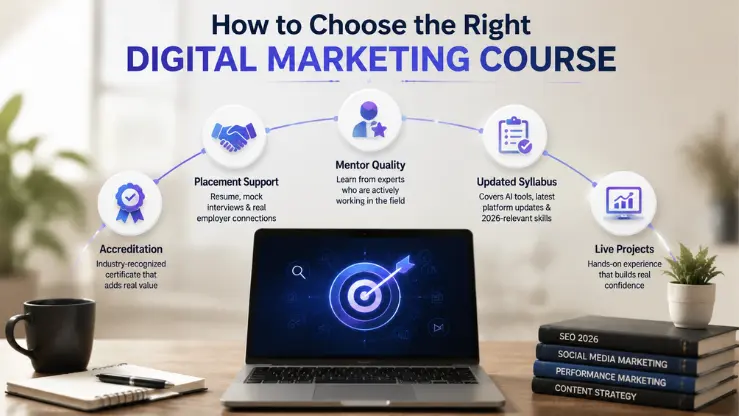
With hundreds of institutes, YouTubers, and “gurus” all selling a digital marketing course today, choosing the correct one has genuinely become harder than learning the subject itself. Everyone’s brochure looks the same—placement guarantees, “industry expert” trainers, and a shiny certificate at the end. The real difference shows up only once you look past the marketing pitch and into what the course actually delivers day to day. Before you enroll anywhere, run it through this checklist:
- Accreditation—it is recognised by the industry, not just the institute’s own marketing?
- Placement support—resume building, mock interviews, and real employer connections, not just a “placement assistance” line in the brochure
- Mentor quality—are trainers currently working in the field, or teaching from five-year-old notes?
- Updated syllabus—does it include AI tools, current ad platform changes, and 2026-relevant SEO practices?
- Live projects—real campaigns beat recorded lectures every time
If a course claims a guaranteed job or guaranteed salary, treat that as a red flag rather than reassurance—legitimate programs talk about “support” and “outcomes,” not guarantees.
Common Mistakes to Avoid Before Enrolling
- Choosing a course purely because it’s the cheapest option available
- Ignoring whether the syllabus has been updated in the last 12 months
- Not checking if the certificate actually holds recognition with recruiters
- Skipping the demo class or trial session most institutes offer
- Assuming an expensive course automatically means better quality—it doesn’t always
- Not asking current or past students about their real placement outcomes
Conclusion
A Digital Marketing Course can genuinely be one of the highest-ROI decisions you make for your career in 2026—but only if you choose it the way you’d choose any serious investment: with research, not hype. Look past the brochure. Check the syllabus, the mentors, and the real outcomes of people who’ve already been through it. Whether you’re a student, a career switcher, or a business owner wanting to run your own campaigns, the right digital marketing course pays for itself fast—the wrong one just becomes an expensive PDF you never open again.
FAQs About Digital Marketing Course
Is a digital marketing course worth it in 2026?
Yes, for most learners—especially when the course includes live projects and placement support. The ROI, based on current fresher salary data, is significantly higher than most traditional degree investments.
Which is the best digital marketing course for beginners?
Start with a free foundational course like Google’s Fundamentals of Digital Marketing to test your interest, then move to a paid program with hands-on projects once you’re sure this is the direction you want.
Can I learn digital marketing without a course?
Technically yes, through free resources and self-practice, but a structured digital marketing course compresses years of trial-and-error into months and adds a credential recruiters recognise
How long does a digital marketing course take?
Anywhere from a few weeks for a certification to 12–18 months for an executive PG program, depending on depth and career level targeted.
What is the average fee for a digital marketing course in India?
Beginner-level programs can start from as low as ₹10,000, while premium postgraduate courses can run into several lakhs, with most solid mid-range programs falling between ₹40,000–₹1,50,000.


Recommend The Best Learning Path Tailored To Your Needs
Discuss your career goal with experienced trainers for clarity.

